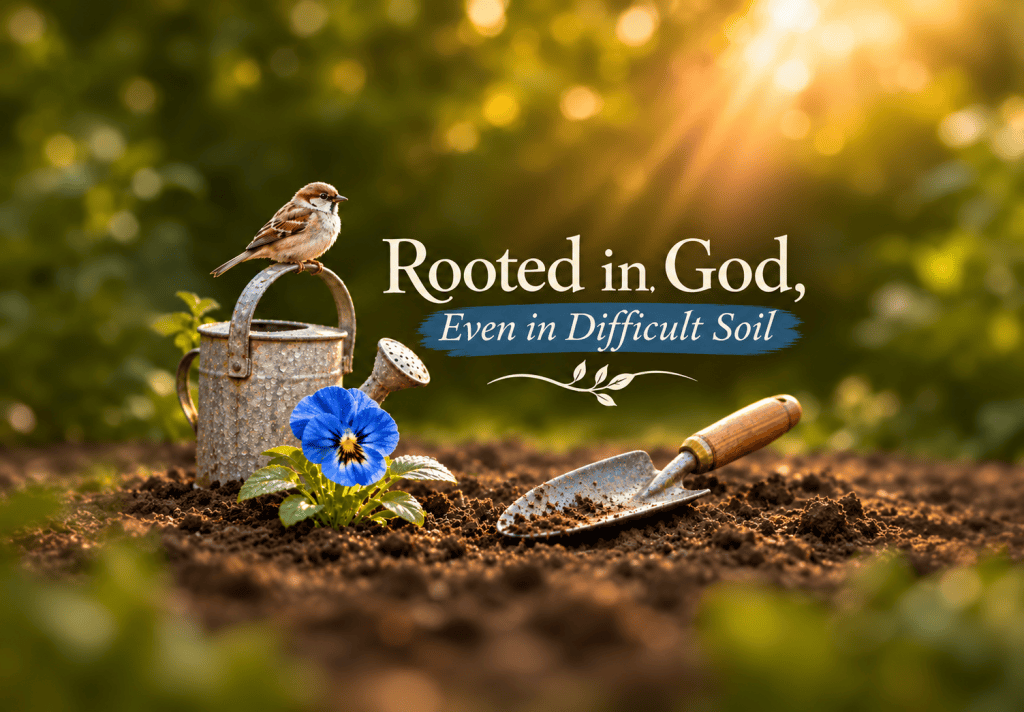
We’ve probably all heard the phrase, “Bloom where you’re planted.”
It’s a beautiful concept, isn’t it? It’s an easy idea to stand behind when life is simple and everything seems to be going our way.
We like to imagine having a job that sets us up for life. We settle our roots into it, slowly creeping up the career ladder like ivy climbing a trellis. As time goes on, perhaps we find ourselves able to afford that house with the white picket fence. I’m not sure why that’s always the imagery people use, but there you go. Moving on…
Maybe we get married, have a kid or two, and settle into the life we’ve always imagined, eventually enjoying the retirement we’ve dreamed of. Life is nice and dandy. It’s easy to imagine blooming when we’re planted in that kind of soil. And there is absolutely nothing wrong with that life or with wanting it.
But what happens when the soil isn’t so favorable?
Now, before we go any further, I want to clarify something. There isn’t actually a Bible verse that says, “Bloom where you’re planted.”
I know, I know. I’ve mentioned before how important it is to be careful not to put words into God’s mouth or claim that the Bible says something it doesn’t. So, I’ll be the first to admit that this particular phrase isn’t found in Scripture. However, we do find examples throughout the Bible of people learning to grow in circumstances they never would have chosen for themselves.
Joseph and Ruth are two examples that immediately come to mind. But today, I’d like to welcome another familiar face: our friend Esther.
First, we need to prepare a little soil for Esther’s backstory.
Her cousin Mordecai came from a Jewish family whose history was rooted in exile. His ancestors had been taken from Jerusalem and brought into Babylonian captivity under King Nebuchadnezzar.
We all know that name. He was the same king who took Daniel into captivity, another familiar name whose story fits the concept of blooming where you’re planted. Same king, but different conquests and captivities.
Later, Mordecai was living in Susa, one of the royal capitals of the Persian Empire, under the rule of King Ahasuerus.
King Ahasuerus and his wife, Queen Vashti, had quite the falling-out. There was more to this quarrel, but for brevity’s sake… After consulting his advisers, Ahasuerus decided that Vashti would no longer be queen and that he now needed a new wife. Eventually, the search for the new queen began.
This is when we’re introduced to Esther.
We don’t know how her parents died. We know that she was an orphan and that Mordecai, her cousin, had taken her in and raised her as his own daughter. We’re also told that Esther was a very beautiful young woman.
When the search for a new queen began, Esther was one of the young women taken into the palace. Mordecai instructed her not to reveal her Jewish heritage, and she obeyed. Scripture doesn’t specifically tell us why he gave her this instruction. Maybe he was acting like an overly protective father, watching his adopted daughter head into the unknown. We don’t know, but keeping her heritage concealed may have helped protect her in an unfamiliar environment.
Once inside the palace, Esther joined the other women in undergoing preparations before being presented to the king. And this wasn’t a quick process, either!
Esther 2:12 tells us that each woman went through twelve months of preparations. The first six months were spent using oil of myrrh, followed by another six months of perfumes and beauty treatments.
Now, don’t get me wrong, the beauty treatments don’t sound like a bad deal to me! But I imagine it would be nerve-racking to spend an entire year preparing for an uncertain future, knowing that the king might not choose you after all that time.
And here’s something to consider. If you look at Esther 2:14, you’ll notice that after being presented to the king, the women were moved into a second harem, overseen by the official in charge of the king’s concubines. They would not return to the king unless he was pleased with them and summoned them by name.
So, not being chosen as queen didn’t mean freedom. What happened to the unchosen women afterward? Did they have to remain there until the king was no longer king, or until he grew tired of them? We don’t know. Scripture doesn’t tell us.
One thing is clear: Esther had very little control over what her future would look like.
Yes, from the outside looking in, the soil might have looked glamorous and rich on the surface, but the deeper you dug, the more you would discover just how rocky it really was.
When Esther’s turn came, she won the king’s favor, and he made her queen. She still kept her heritage a secret, just as Mordecai had instructed her.
One day, Mordecai learned that two officials were plotting to assassinate the king. He told Queen Esther, who passed the information along to her now-husband. An investigation followed, and once the accusations were verified, the two officials were put to death.
Not long after this, the king promoted one of his officials, Haman, to a position above all the other officials. The king commanded his servants at the royal gate, where Mordecai also spent time, to bow down to Haman every time he would pass by.
But Mordecai refused.
Time and time again, Haman would pass through the gates, and Mordecai would still refuse to bow.
This infuriated Haman. The new power Haman had been given went directly to his head. The thought that one man would dare not bow soon blinded Haman with rage. When Haman discovered Mordecai was a Jew, his anger consumed him. It wasn’t enough for Mordecai to die. He wanted Mordecai’s entire people destroyed.
Haman eventually approached the king with a disturbing proposal. He described a certain group of people who didn’t obey the king’s laws and suggested that if they weren’t tended to it would only cause problems for the king. How convenient that he withheld important information, like who he was specifically mad at. In hopes of making the proposal more appealing, Haman offered the king a large sum of silver if he agreed to have them destroyed.
Apparently, money talks, even back then. The king agreed to Haman’s proposal, and soon it became an order.
I promise you, this is really about Esther. Remember that Esther had been keeping her Jewish heritage a secret? That secret was about to be threatened.
Before we get there, we have to go back to Mordecai. I know, bear with me.
When he learned of this order, he was devastated. He tore his clothes, put on sackcloth, and covered himself with ashes as he publicly mourned. Eventually, word of his grief reached Esther, and Mordecai urged her to go before the king and plead for her people.
Yet, Esther knew that if she went before the king without being summoned, and he did not accept her presence, she could face the death penalty.
Mordecai pressed her again, reminding her that this could mean the death of an entire people. He also reminded her that being queen didn’t guarantee her safety if her Jewish heritage was ever discovered. Then he spoke the words that some of us know very well:
“Who knows, perhaps you have come to your royal position for such a time as this.” – Esther 4:14
After asking her people to fast, Esther made the frightening decision. She would go before the king, unsummoned, and plead for the salvation of her people.
When she appeared before him, he accepted her presence, and she was given permission to make her request. Our friend Esther was tactful. Instead of spilling everything right then and there, she requested the presence of the king and Haman at a banquet she had prepared for them. The king accepted.
Once both Haman and the king were happy and fed, the king asked Esther what she desired. She held her tongue, instead requesting their presence at another banquet the following day. Was Esther procrastinating out of fear? Or was she taking time to make herself even more “pleasing” to the king so she knew she would have his ear? Possibly. We don’t know.
They accepted. Haman left happy, until he passed Mordecai, who didn’t bow, of course. His happiness quickly turned to seething rage. Following the advice of his wife and friends, Haman had a structure seventy-five feet tall built for Mordecai’s execution. Some translations refer to this structure as a gallows. Either way, what a wonderful friend and family group to surround yourself with. He planned to ask the king to have Mordecai killed before attending Esther’s next banquet.
So much happened between then and the conclusion, but when the time came, Esther took courage and spoke out for the Jews, revealing her heritage in front of both Haman and the king.
When the king learned of Haman’s plot, he ordered Haman’s death on the very structure Haman had prepared for Mordecai. Mordecai was later given Haman’s position of authority. Although the original decree could not be revoked, another decree was made allowing the Jews to defend themselves. They survived the threat against them.
You ever feel stuck in the circumstances you’re in? Maybe you have no idea how God could even use you in the very place where you feel so stuck.
Trust me, I feel that.
Around the time that I had decided to prepare my mind to allow God to use my pain, instead of continuing to fight Him on the issue, I found myself on bed rest again. I became very discouraged and felt like I was so pointless. I wasn’t thinking about doing anything harmful to myself, but I sure questioned God as to why He even made me.
The VeggieTales song “The Pirates Who Don’t Do Anything” was consistently stuck in my head. Though it was a silly song, I seemed to find a depressing undertone to it. When I realized I had been sitting in those feelings for too long, I brought everything I had been wrestling with to God, as I had been doing, but I also brought it before my earthly father.
He listened patiently, allowing me to get all of my frustrations out. After listening, he told me to “Bloom where you’re planted.”
I asked Dad, “How?”
I was in bed. I couldn’t do anything for myself. No one outside of the house was visiting, so I couldn’t even try to do life with others.
Dad encouraged me to use Facebook as a mini blog. That wasn’t the word he used, but I’m going with it. He reminded me that many people use Facebook to show the happy parts of their lives. They don’t allow others to see the downright difficult. That’s understandable. Who wants to allow others to see the nitty-gritty of their lives? But what if that’s what others need to see? What if they need to see honesty for once? What if they need to see that they aren’t alone in this difficult thing called life?
Not everybody needs to see every aspect of our lives on social media, but what if allowing them to see a smidge of the good, the bad, and the devastating could help them? Why don’t we? We always see the smiling faces, but why not share what it took to get those smiling faces?
Dad also encouraged me not only to share some of the difficult things but also share what God was teaching me during that time.
Though I still didn’t get visitors, people would comment about how grateful they were for my posts. Not only was posting these things encouraging me, because it reminded me of God’s work, but it was also encouraging others.
This is something that has stayed with me over the years. At times, I feel like I almost post too much, so apologies to any of my friends on Facebook reading this. Yet whenever I hint about posting less, I have others privately reach out, thanking me for posting because it gives a voice to others with chronic illness or pain. Or it has served as a reminder of God’s work in their own lives!
Dad also suggested that I reach out to others when they came to mind. Others might not have been doing that for me, but that didn’t mean I couldn’t do that for them.
So, when people come to mind, even to this day, I reach out. I may never know whether God was the one who laid them on my heart. What if they were going through their own trials? What if they really needed that text?
I might have been in bed, but that didn’t mean my heart or my mind needed to be sedentary. I found my roots growing deeper into the foundation of God. All of these things were meant to encourage others, yet they changed my heart stance. Of course, I wasn’t excited about my circumstance, but I refused to allow them to have full control of every aspect of my life. That season taught me life lessons and so much about God.
We want to get out of difficult circumstances. The last thing we want is to stay in the uncomfortable soil, and many times, we beg God for an escape. It is okay to ask for release. But what do we do when He asks us to stay planted in that soil? Do we refuse to grow, or do we secure our roots and flourish in Him?
Here is the thing, too, and one of my favorite parts of Esther’s story: In the middle of all her difficult circumstances, she could only see her present. She had no idea how God would use everything that had led her to that moment: her family’s history, Mordecai’s position in the king’s court, his decision to adopt her, and her becoming queen. All of it was used. It wasn’t wasted.
God even used Mordecai and Esther’s connection to give the Jewish people a voice inside of the king’s court. Esther took courage and allowed herself to be used by God in circumstances she never would have chosen for herself, helping to save her people.
Esther’s soil was not preferable. Nothing about her circumstances was simple, yet she allowed herself to be used by God while she was there.
And in doing so, her courage helped save a people through whom, roughly 450-500 years later, Jesus Christ, the Son of God, would come into the world.
In that moment, she couldn’t have known the impact she would make as she bloomed where she was planted.
I may never be like Esther. I’m not holding my breath on that. I don’t imagine that my blog will save an entire people group, but if it could encourage you, dear reader, that would be enough. If it could encourage you to use your circumstances to help you grow closer to your Heavenly Father, to God be the glory!
Though my soil continues to change, there are aspects of it that remain the same. The soil of pain is ever present. So, I will continue to remain rooted in my Heavenly Father and grow along the way.
Selah: What is the circumstance that has become the soil you want to escape? It’s okay to try to get out of it, whether that means finding a new job, home, or something else. But what are you doing in the meantime? Are you rooting yourself in God’s Word and allowing Him to help you grow in the middle of it? Are you doing so even if your circumstances are wonderful at this moment in time? What steps can you personally take today to bloom where you’re planted?


Leave a Reply