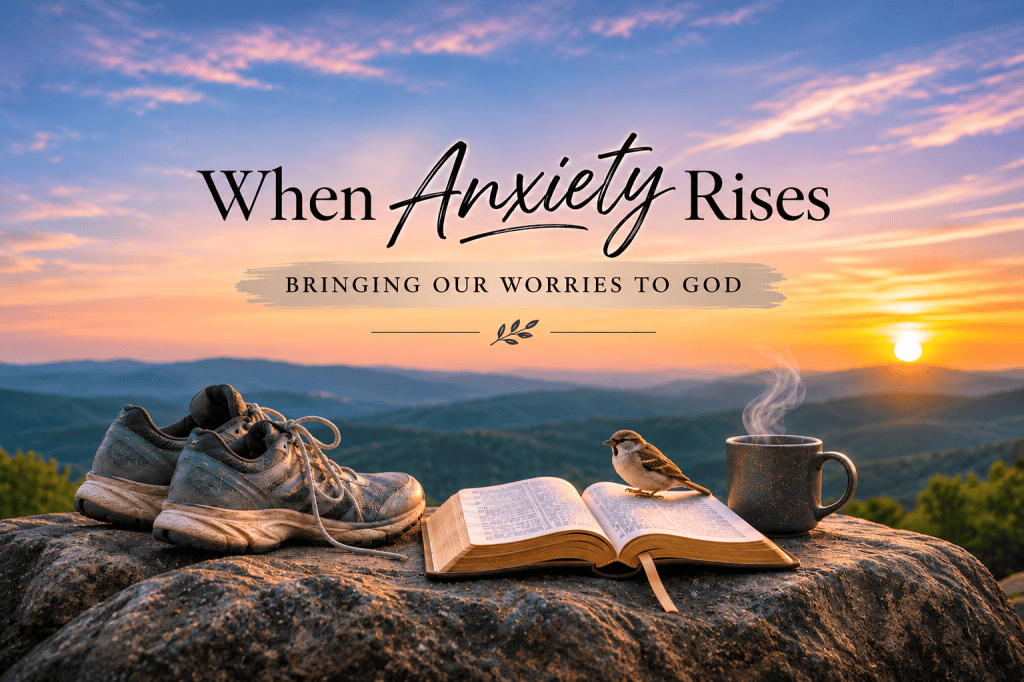
“Don’t worry about anything, but in everything, through prayer and petition with thanksgiving, present your requests to God. 7 And the peace of God, which surpasses all understanding, will guard your hearts and minds in Christ Jesus.“
– Philippians 4:6–7 (CSB)
In other translations, it says, “Be anxious for nothing.”
What does this mean, and what does it mean for the Christian who struggles with anxiety?
Let me start by saying that this doesn’t mean that once you become a Christian, you will never feel anxious. And it doesn’t mean that if you struggle with anxiety, you are necessarily sinning.
Anxiety is a real human experience.
“1 God, listen to my prayer
and do not hide from my plea for help.
2 Pay attention to me and answer me.
I am restless and in turmoil with my complaint,
3 because of the enemy’s words,
because of the pressure of the wicked.
For they bring down disaster on me
and harass me in anger.
4 My heart shudders within me;
terrors of death sweep over me.
5 Fear and trembling grip me;
horror has overwhelmed me.
6 I said, “If only I had wings like a dove!
I would fly away and find rest.” – Psalm 55:1-6
David acknowledges that he is terrified. If you dig deeper into this chapter, you’ll discover that one of his enemies is someone he once called friend.
Throughout the Psalms, David describes the fear and distress he experienced while being pursued by enemies who want him dead. Imagine how much that would wear on a person.
“Not to mention other things, there is the daily pressure on me: my concern for all the churches.” – 2 Corinthians 11:28
Paul describes his concern for the churches at the conclusion of a list of hardships he endured while spreading the gospel.
Think about any time that an angel miraculously appeared to someone in the Bible. What did they tell them?
“Don’t be afraid.”
Why? Because a random, luminous stranger just appeared out of nowhere! Wouldn’t you be scared? Startled, even?
And no, those images circulating online of “biblically accurate angels” aren’t necessarily accurate. They often combine descriptions of seraphim, cherubim and other living creatures from Isaiah 6, Ezekial 10, and Revelation 4 into one terrifying picture!
Either way, when angels suddenly appeared and told people, “Do not be afraid,” they aren’t proclaiming, “You are sinful for being afraid,” or “How dare thee be afraid!”
No, it’s like when a child is afraid of the monster in the closet. You acknowledge their fear, but because you are with them, protecting them, you reassure them that they can rest in your presence.
The only difference is that, in the moment, it might have felt like the angels were the monsters in the closet.
All of that to say, when Scripture tells us, “Fear not,” “Do not be afraid,” “Be anxious for nothing,” it isn’t denying the reality of fear and anxiety.
But here’s the question: What are you going to do with them?
And how does this apply to those Christians who struggle with anxiety?

Let me stop here and say that I am not a therapist. I am only speaking from my own experience. I understand that not everyone’s experience is the same as mine, and what I’ve found helpful may not be helpful for everyone.

I have always experienced anxiety here and there, even as a kid, but it was never fully consuming.
My biggest run-in with anxiety as a kid was math tests.
I could read and write. Those had been strengths of mine since preschool, but math and I have never been friends. We still aren’t on speaking terms.
I had a teacher who, for some reason, decided to time me on each problem in front of the entire class. Once the alarm went off, she would announce that I needed to move on.
Needless to say, I flunked.
Thankfully she never did that to me again. That decision was probably made easy by the fact that I spent the entire test weeping in front of my classmates, completely embarrassed and stressed out of my mind.
My anxiety usually was rooted in my performance on tests. It wasn’t due to pressure by my parents, but rather the pressure I put on myself.
Either way, I never experienced a full-blown anxiety or panic attack until adulthood.
It was after my second-to-last surgery.
The last few surgeries are still very difficult to talk about, and even writing this is anxiety-inducing, so bear with me.
This is a part of me that I normally don’t address because it is “easier” to ignore it.
I’ve heard people say that you can’t help others until you’ve healed yourself. I couldn’t disagree more. Sometimes, sharing the very things we tend to avoid can be part of the healing process.
I hope that sharing my experience might help others, so here goes nothing.
My second-to-last surgery wasn’t even supposed to happen.
I’ve mentioned before that I had nine screws in my pelvis. After the last round of screws were put in, I began experiencing intense pain whenever the weather changed.
Eventually, I found a doctor who listened. He remembered my nickel allergy and explained that even surgical-grade screws contained a small amount of nickel.
My surgeon couldn’t promise that this was causing my pain, but we decided to remove the screws just in case.
After the first round of removing the screws from the left side of my pelvis and hip, I found out why they try to leave those screws in place.
I thought I knew pain until pain was what woke me up in recovery.
Before I was even fully conscious, I had already asked God to take me home. The pain was that excruciating.
I was completely clearheaded despite just waking up from anesthesia.
I refused to look at the surgical site because every nurse, and even my mom, a former nurse, kept apologizing for how badly my hip looked.
As they moved me to my room, I clutched the hand of anyone who offered theirs, nearly breaking it as they tried quickly to get me the pain medication pump.
After going through all of that, as the next surgery to remove the remaining screws drew closer, the realization came over me like a heavy plastic bag that began to suffocate me.
I began to hyperventilate.
I went to my room, trying to calm myself down and breathe while bringing my fear before God. But I had never experienced that level of panic before.
Eventually, I went to my mom. I could barely get enough words out to explain bits and pieces of what I was experiencing between gasps of air.
She didn’t understand, but she didn’t need to. She could see that I was not okay, and that was enough for her.
We stood there as she held me, waiting patiently until I calmed down.
The last surgery was just as painful, but at least the surgical site didn’t look as bad.
So that’s something.
A few months after recovery, I started experiencing sleep paralysis.
I would open my eyes and see terrifying things happening around me, unable to move no matter how badly I wanted to.
This happened off and on for months. It was like being trapped in a carefully scripted psychological horror film.
My first instinct was to tell no one. I felt like I was going crazy, but sometimes holding on to those things and hiding them from others can keep you ensnared by them.
Eventually, I talked about it with two friends of mine, one a doctor and the other a therapist.
They suggested the same possibility: I might have slightly woken up during one of my surgeries and was reliving it in my dreams.
The possibility is all my brain needed. After that conversation, I no longer experienced those episodes.
Do I know that’s exactly what happened? No, but I am not going to question it.
In the years that followed, I experienced more anxiety when unexpected things triggered memories of the past.
I could be watching a movie or TV show I’d seen before, only for something to suddenly take me back to those moments, those smells, those noises, and the pain.
Sometimes, it was something as routine as going into a sporting goods store to get new running shoes.
As the doors opened, a gust of air carried the smell of cleaning products that made the whole store smell like a hospital.
Suddenly, I was standing in the shoe aisle, feeling like I was fighting for my life, but refusing to leave without those shoes because I didn’t want my anxiety to keep me captive.
I ended up having a full-blown panic attack after getting back into my car, but afterward, I felt a sense of accomplishment because I still got what I came for.
Still, just writing about this is bringing on a sense of anxiety, and I’m experiencing something almost like a phantom pain in my left hip.
It’s a quieter version of the excruciating pain I experienced immediately after surgery, different from the chronic pain I live with today. I don’t normally experience that particular pain anymore, except during moments like these.
But instead of stopping entirely, I’m going to continue because this is part of the healing process, and this isn’t just for me.
I’m just going to take a walk first before I keep going…
Okay, I’m back. Sort of ready to continue.
During those moments, I would get so mad at myself.
None of it seemed logical. I would try to tell my mind and my body that I was safe, but my body’s response to anxiety felt so out of control.
I felt guilty, as if I had sinned.
There was no logic to be found in my reaction. Yet, my body kept account of everything that happened to it, and it didn’t seem to care that we weren’t going through those experiences anymore.
Though the last two surgeries were the breaking point, my body had endured seven surgeries back-to-back, with no real break.
My mind and body reached their limit.
I felt completely broken. I had survived the hardships and trials those surgeries brought, yet I was left feeling as though my mind was broken, too.
After another profound panic attack in front of my family, I decided I needed to figure this out because it was controlling so many parts of my life.
Should I have gone to a Christian therapist? Possibly. Should I still? Maybe.
Do I have all of this handled? Nope, but it is better than it was.
I’ve only experienced one other full-blown panic attack since then, last year, when a series of circumstances created the perfect storm.
Some people need extensive therapy or medication to help manage what they’re experiencing. And that is okay!
People have gone through unspeakable things, and for many, learning how to work through those experiences takes time and healing.
We normally think of anxiety and imagine someone out of control, hyperventilating, and panicking.
Yet a lot of times, it looks like control on the outside while the inside feels like a storm.
You might be actively praying, going through a mental checklist, trying to pinpoint why you’re anxious, and doing a body scan to figure out whether it’s because of a flare-up or something else.
Sometimes, even after all of that, you find no reason for your anxiety.
Your body and mind just decided to be special that day.
So, what do I do in either circumstance?
When I feel anxiety rise, I run to God.
I tell Him how I’m feeling. I put on worship music and go through my checklist again.
I remind myself of what is true. I remind myself that I am safe, that God is with me, and He is in control even when my mind feels out of control.
I become aware of my breathing and work on not invalidating what I’m feeling, or calling myself stupid or weak.
Sometimes, I tap a rhythm on my collarbone because I can feel it through a good portion of my body, giving me something else to focus on.
I also reach out to trusted friends who know about my anxiety. I ask them to pray and sometimes explain what triggered it.
That allows me to process what I’m experiencing, whether verbally or through a text.
All of this goes against what I used to do.
For years, I buried emotions that seemed negative because I thought I had to do so to survive. But they could only stay buried for so long.
Eventually, I had to learn how to process them differently, bringing them into the light, laying them at Jesus’ feet, and sharing them with trusted friends who helped me walk through them.
It seems like a lot of extra work because it is, but it is a battle for the mind.
It will take work, and it will take time.
The more I face my anxiety, the better I learn to walk with it. I’m thankful for my progress and hopeful that one day, with God’s help, I might conquer it.
Either way, I’m thankful for how much progress I’ve made.
If you need therapy or counseling, I believe that, as Christians, our approach should reflect our faith.
We’re called to live differently from the world, so shouldn’t that influence how we seek help, too?
“3 When I am afraid,
I will trust in you.
4 In God, whose word I praise,
in God I trust; I will not be afraid.
What can mere mortals do to me?” – Psalm 56:3-4 (CSB)
David is obviously not saying that he is never afraid.
No, he says that when fear comes, he makes the decision to trust God.
He trusts God, and he praises God.
During those times when my brain feels out of control, I remind myself in Whom I trust.
Even when I might be fighting to breathe, at some point in the struggle, I have trained myself to praise God.
It might be sloppy and messy, but that is okay!
It isn’t about how it looks or sounds. It’s about bringing it to the One who can handle it.
The anxiety is real. The storm is real.
Even when you feel as if you’ve lost control of your mind, that feeling itself is not sin.
When your heart feels like it is racing and pounding against your chest, that physical response isn’t sin, either.
When you’re running or working out, your heart rate changes. You can train your body, but your heart won’t always respond exactly as you want it to.
We don’t call an increased heart rate during exercise sin, so why would we call a racing heart brought on by painful memories sin?
When someone grieves, don’t we sometimes find ourselves crying? Does God call those tears sin?
No.
We need to stop treating these involuntary responses as sin and placing that burden on ourselves and others.
Again, the anxiety is real, but what we do with it makes a difference.
If your anxiety feels far heavier than you thought you could handle one day, you haven’t failed God.
I am thankful that we serve an understanding God, even when we don’t fully understand our own minds.
So, what do we do when anxiety comes?
Let’s return to the verses that started this conversation.
“Don’t worry about anything, but in everything, through prayer and petition with thanksgiving, present your requests to God. 7 And the peace of God, which surpasses all understanding, will guard your hearts and minds in Christ Jesus.“
– Philippians 4:6–7 (CSB)
Paul doesn’t just tell us not to worry. He tells us what to do with our worries.
Bring them to God.
Not just the “little” things or the worries we can explain away.
Paul says “everything.”
We can bring anything and everything before God.
Will we always get immediate relief? Not always, but it gives me Someone to actively turn my mind toward.
It might even look like praying as you take a walk or run, giving your heart a reason to be pounding against your chest.
These verses remind us to bring our worries to God, and they give us a promise of His peace.
God’s peace is not something that I can create through my own strength. It comes when I acknowledge my weakness and turn to Him, trusting that He will meet me there.
It is peace that He gives, not something that I have to manufacture on my own.
And if that storm doesn’t immediately quiet, we can continue bringing our anxieties to the One who remains faithful.
Selah: What are you carrying today that feels like it has taken hold of your mind? When you feel those emotions, do you try to rely on your own strength to get through them, or do you bring them to God? Have you stopped to bring those worries and anxieties before Him today? If not, let’s pray together now.
“Lord, I’m afraid and so anxious. Please help me trust You. Help my mind rest in You. Amen”


Leave a Reply